
Third Straight Month
According to a recent Reuters poll , investors are increasingly bullish
on emerging market Asian
currencies, including
the Taiwan dollar,
Indonesian rupiah,
Singapore dollar,
Malaysian ringgit,
Philippine peso, South
Korean won, and Indian
rupee. The Thai Baht
wasn’t covered by the
poll, but given its
strong performance over
the last few months, it
seems safe to include it
in the bunch.
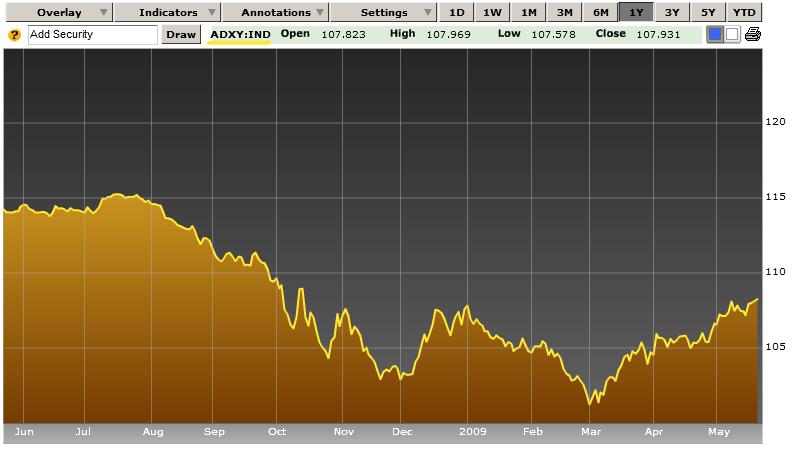
This uptick in sentiment is somewhat unspectacular, since “The
Bloomberg-JPMorgan Asia
Dollar Index, which
tracks the 10
most-active regional
currencies,” has now
risen for almost three
consecutive months [See
chart below]. Leading
the pack are the Taiwan
Dollar and South Korean
Won, which recently
touched five-month and
seven-month highs,
respectively. “The
Korean currency has
climbed 28 percent since
reaching an 11-year low
of 1,597.45 in March.”
Investors are now pouring money back into Asia at rapid clip. “Asia
ex-Japan received $933
million in the week
ended May 20, the most
among emerging-market
stock funds, bringing
the total this year to
$6.9 billion .”
Meanwhile, the “The MSCI
Asia Pacific Index of
regional stocks climbed
22 percent this quarter”
while Chinese stocks are
up 45% since the
beginning of 2009.
But it’s unclear - doubtful is a
better word - whether
this rally is supported
by economic
fundamentals. One
commentator summarized
this contradiction as
follows: “Improved
sentiment has led to a
massive resurgence in
flows to emerging
markets, irrespective of
the underlying data,
which remains weak.
Investors are going out
of dollars to riskier
markets, riskier
currencies."
Let’s drill down into some of the data. Chinese exports fell 15% in
April. Japan’s economy
contracted 15% in the
most recent quarter.
Singapore’s exports are
down 20% on an
annualized basis. The
South Korean economy is
projected to shrink by
2% this year. The
Central Bank of Thailand
just cut its benchmark
interest rate to an
unbelievable 1%. The
only bright spot
economically is Taiwan,
which is benefiting both
from improved economic
ties with China and a
healthy current account
surplus. I suppose
everything is relative,
as “developing Asian
economies will
grow 4.8 percent in
2009, even as the world
economy contracts 1.3
percent” according to
the International
Monetary Fund.
The notion that the rally is not rooted in fundamentals is shared by
the region’s Central
Banks, which clearly
realize that economic
recovery will be much
more difficult in the
face of currency
appreciation. One
analyst argues that,
“Until the signs of
global economic recovery
become more convincing,
central banks will
unlikely tolerate
significant currency
appreciation." The
Central Banks of South
Korea, Taiwan, and
Indonesia have already
actively intervened to
hold their currencies
down, while Malaysia and
Singapore (discussed in
a
Forexblog post last
week) have also
intervened for the sake
of stability.
As a result, this rally could soon begin to lose steam. “A ‘correction’
in regional currencies
is ‘appropriate’
following recent gains,”
said one analyst.
Another has called the
rally “overdone.” Still,
Central Banks and
economic data pale in
comparison to capital
flows and risk/reward
analysis. In short,
these currencies (and
other investments) will
continue to find buyers
for as long as there are
those hungry for risk.
Citigroup, whose “Asia-Pacific
foreign-exchange volume
may rise about 10
percent from the first
quarter,” is bullish. A
representative of the
firm declared: “Fund
managers are still
’sitting on lots and
lots of cash’ so the
pickup in volumes will
continue.”


ليست هناك تعليقات:
إرسال تعليق