News

Custom Search
الأربعاء، 24 يونيو 2009

Exotics
Exotic currencies are the currencies which have limited dealings and very little liquidity. Exotic currencies are neither minor nor major currencies. Some of the minor currencies include Canadian Dollar, Australian Dollar and New Zealand Dollar. On the other hand, the minor currencies in the forex market are U.S. Dollars, Euro, Japanese Yen and Swiss Francs. The exotics play an extremely vital role in forex trading and are equally important as are the major currencies.
Few examples of the exotic currencies include Uruguay Peso, Thai Baht, and Iraqi dinari. It can often be extremely expensive of trade in exotic currencies as the bid-ask spread is usually quite large.
The role of the forex market as the one and only domain for financial institutions as well as major banks like the U.S. Federal Reserve is immensely important. The Forex market has been highly success in helping the banks and financial institutions makes substantial profit which is now offered to the common people. Most countries of the world have now become dependent on each other because of a hike in the foreign investments and worldwide trade.
The economic condition of a country can have a huge impact on the fluctuations of the value of the currency of that particular country as the various economic facts affect the currency’s rate of interest. Thus, the monetary health of a country is determined by the appreciation or depreciation of the value of the country’s currency.
Exotics terms and definitions
Geek: a Quant
Free floating currency: It stands for the currency that has an exchange rate which varies in comparison to other currencies.
Majors: The most widely traded and liquid currency pairs. Major currency trades constitute almost 90 percent of the Forex trading in total.
The top most traded currencies in the forex market are:
U.S. Dollars: The price index determine the relative strength of weakness of the Dollar. When the index figure is large, it means that the value of Dollar is stronger. In the same way, when the index figure is small, it indicates that the value of dollar has not depreciated.
Euro: The adoption of a single currencies by all countries of the European Union has sowed seeds of the creation of what is known as “Euroland”. In total, 11 countries of European Union use Euro as their currency including Spain, Italy, France, Belgium, Austria, Portugal, Luxembourg, Ireland, Finland, Germany and Netherlands. All these nations together have over 300 million people living in it and account for over 20 percent of the total world economy. It also represents the hugest foreign market of the world.
Japanese Yen: Japan continues to be the undisputed global power in economy even in today’s competitive marketplace. After the second world war, the government of Japan has applied all its resources and energy into the development of its economy. As a result of this, it has now become one of the largest economic power throughout the world. Thus, the Japanese Yen is also the 3rd most widely traded currency.
Like this post?
Few examples of the exotic currencies include Uruguay Peso, Thai Baht, and Iraqi dinari. It can often be extremely expensive of trade in exotic currencies as the bid-ask spread is usually quite large.
The role of the forex market as the one and only domain for financial institutions as well as major banks like the U.S. Federal Reserve is immensely important. The Forex market has been highly success in helping the banks and financial institutions makes substantial profit which is now offered to the common people. Most countries of the world have now become dependent on each other because of a hike in the foreign investments and worldwide trade.
The economic condition of a country can have a huge impact on the fluctuations of the value of the currency of that particular country as the various economic facts affect the currency’s rate of interest. Thus, the monetary health of a country is determined by the appreciation or depreciation of the value of the country’s currency.
Exotics terms and definitions
Geek: a Quant
Free floating currency: It stands for the currency that has an exchange rate which varies in comparison to other currencies.
Majors: The most widely traded and liquid currency pairs. Major currency trades constitute almost 90 percent of the Forex trading in total.
The top most traded currencies in the forex market are:
U.S. Dollars: The price index determine the relative strength of weakness of the Dollar. When the index figure is large, it means that the value of Dollar is stronger. In the same way, when the index figure is small, it indicates that the value of dollar has not depreciated.
Euro: The adoption of a single currencies by all countries of the European Union has sowed seeds of the creation of what is known as “Euroland”. In total, 11 countries of European Union use Euro as their currency including Spain, Italy, France, Belgium, Austria, Portugal, Luxembourg, Ireland, Finland, Germany and Netherlands. All these nations together have over 300 million people living in it and account for over 20 percent of the total world economy. It also represents the hugest foreign market of the world.
Japanese Yen: Japan continues to be the undisputed global power in economy even in today’s competitive marketplace. After the second world war, the government of Japan has applied all its resources and energy into the development of its economy. As a result of this, it has now become one of the largest economic power throughout the world. Thus, the Japanese Yen is also the 3rd most widely traded currency.
Like this post?
Asian Currencies Rally for Third Straight Month
sian Currencies Rally for
Third Straight Month
Third Straight Month
According to a recent Reuters poll , investors are increasingly bullish
on emerging market Asian
currencies, including
the Taiwan dollar,
Indonesian rupiah,
Singapore dollar,
Malaysian ringgit,
Philippine peso, South
Korean won, and Indian
rupee. The Thai Baht
wasn’t covered by the
poll, but given its
strong performance over
the last few months, it
seems safe to include it
in the bunch.
This uptick in sentiment is somewhat unspectacular, since “The
Bloomberg-JPMorgan Asia
Dollar Index, which
tracks the 10
most-active regional
currencies,” has now
risen for almost three
consecutive months [See
chart below]. Leading
the pack are the Taiwan
Dollar and South Korean
Won, which recently
touched five-month and
seven-month highs,
respectively. “The
Korean currency has
climbed 28 percent since
reaching an 11-year low
of 1,597.45 in March.”
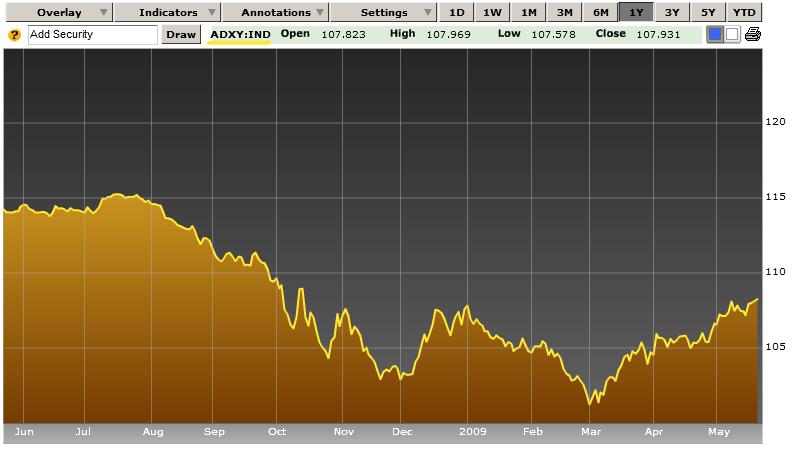
Investors are now pouring money back into Asia at rapid clip. “Asia
ex-Japan received $933
million in the week
ended May 20, the most
among emerging-market
stock funds, bringing
the total this year to
$6.9 billion .”
Meanwhile, the “The MSCI
Asia Pacific Index of
regional stocks climbed
22 percent this quarter”
while Chinese stocks are
up 45% since the
beginning of 2009.
But it’s unclear - doubtful is a
better word - whether
this rally is supported
by economic
fundamentals. One
commentator summarized
this contradiction as
follows: “Improved
sentiment has led to a
massive resurgence in
flows to emerging
markets, irrespective of
the underlying data,
which remains weak.
Investors are going out
of dollars to riskier
markets, riskier
currencies."
Let’s drill down into some of the data. Chinese exports fell 15% in
April. Japan’s economy
contracted 15% in the
most recent quarter.
Singapore’s exports are
down 20% on an
annualized basis. The
South Korean economy is
projected to shrink by
2% this year. The
Central Bank of Thailand
just cut its benchmark
interest rate to an
unbelievable 1%. The
only bright spot
economically is Taiwan,
which is benefiting both
from improved economic
ties with China and a
healthy current account
surplus. I suppose
everything is relative,
as “developing Asian
economies will
grow 4.8 percent in
2009, even as the world
economy contracts 1.3
percent” according to
the International
Monetary Fund.
The notion that the rally is not rooted in fundamentals is shared by
the region’s Central
Banks, which clearly
realize that economic
recovery will be much
more difficult in the
face of currency
appreciation. One
analyst argues that,
“Until the signs of
global economic recovery
become more convincing,
central banks will
unlikely tolerate
significant currency
appreciation." The
Central Banks of South
Korea, Taiwan, and
Indonesia have already
actively intervened to
hold their currencies
down, while Malaysia and
Singapore (discussed in
a
Forexblog post last
week) have also
intervened for the sake
of stability.
As a result, this rally could soon begin to lose steam. “A ‘correction’
in regional currencies
is ‘appropriate’
following recent gains,”
said one analyst.
Another has called the
rally “overdone.” Still,
Central Banks and
economic data pale in
comparison to capital
flows and risk/reward
analysis. In short,
these currencies (and
other investments) will
continue to find buyers
for as long as there are
those hungry for risk.
Citigroup, whose “Asia-Pacific
foreign-exchange volume
may rise about 10
percent from the first
quarter,” is bullish. A
representative of the
firm declared: “Fund
managers are still
’sitting on lots and
lots of cash’ so the
pickup in volumes will
continue.”
How do I begin? Please give it to me SIMPLY
How
do I begin? Please give it to me SIMPLY
1. The best advice on how to learn to trade
profitably is to learn from experts with
proven track records.
Many learning
styles are available to beginners at all
levels:
books, CDs, online courses, group seminars,
even one-on-one mentors who will come right
your home for a few days.
We outline our Forex-Trader picks in
Learning Forex Trading.
Learning to trade from experts is worth
every penny and has saved us untold
thousands in mistakes.
We would not recommend starting forex
trading without any training.
It is not hard to learn, nor difficult to
trade successfully, but you must first
provide yourself with a basic functioning
knowledge of ’the game you’re in’.
2. While you are learning you will need
charting software to practice reading the
Market. Charting is an indispensable tool
that shows you in real-time data what the
market is doing moment by moment and also
what the market has done in the past.
As you learn to analyze these charts you can
determine what trades to enter and exit,
where to set your stop losses, limits etc.
There are several good charting software
services that you can subscribe to online
monthly. See our Forex-Trader tested
Charting Software picks in Tools of The
Trade.
3. Then, to perform your actual trades
online you need a real-time ’trading
platform’ to execute your ’buys’ and ’sells’
directly in the Foreign Currency Market.
You obtain a trading platform from a Forex
Clearinghouse that is connected real-time to
the interbank market.
There are many good Clearinghouses (also
confusingly called Brokerage Firms, Market
Makers, etc.) that provide you with the
trading platform to trade the funds in the
account you have opened with them.
Before you begin trading your ’real’ money,
while you are learning, you will practice on
your own ’demo account’ with play-money in
it, which will be provided to you by the
clearinghouse you plan to trade through. The
contractual relationship you enter into with
your Clearinghouse is a very important one
because the Clearinghouse you choose
determines many trading features and
financial advantages to you both as a trader
and as an investor.
Forex-Trader tested Clearinghouses are
reviewed in Tools of The Trade.
We have outlined a Getting Started path with
uncomplicated steps.
This is the path that we would take if we
were beginning trading over again today with
’what we know now’.
The products and services we mention in
these steps are all ones that we have
personally used for some time with
consistent success. As always you are free
to forge your own path, and if you do, happy
hiking.
There is a mountain of products and services
try out, and if you find ones you like
better we would love to compare notes with
you.
Explain More
About Charting Services
To trade successfully you also must have
good charting software and instantaneous
data feeds critical to helping you analysis
and interpret the movement of currencies
moment to moment so you know when/why to buy
or sell — this you subscribe to monthly.
You can get a 2 week or more demo to
familiarize yourself with one that has the
features you like. The costs also vary, and
some companies require a year commitment.
There are some free charting services
offered through the clearinghouses, but they
tend to lack the tools to be truly useful.
There are also some costly proprietary
Specialty Software charting ’hybrids’ which
are market forecasters tools that look more
like video games than charts.
Explain More
About How Clearinghouses Work
A good clearinghouse (i.e.. your computer
access/link to the live Forex Exchange
Market) is the partner with which you trade
the money you have deposited with them in
your trading account. After trying and
demo-ing many we have found a small handful
that are truly excellent for the beginner
(and continue to be excellent as you grow) —
meaning user friendly, legally accountable
to regulatory bodies, and offering fair
costs (spreads) for their services/trading
software platforms.
There still are many worrisome ones
practicing in this closing era of
unregulated forex trading (new Commodities
laws are imminent).
The topic of matching the right
clearinghouse for your needs is discussed
more in Tools of the Trade, because it
depends on a number of factors — how much
you can open an account with,
how much the
clearinghouse profit spread, what
your liquidity needs are, your
minimum/maximum stop loss and margin
requirements, even where you live and how
much time you have to give to trading in a
24 hr. day.
How Much Does
it Cost to Begin to Trade?
Learning to trade will entail the cost of
books and whatever traiining method you
choose.
It will also include a reliable computer
with a minimum 128 Mb of memory to run the
charting software and trading platform.
Ongoing ’costs of operation’ include the
monthly costs of high-speed internet,
charting software, the email forecasting
subscriptions — plan on spending $150./mo.
up for ongoing costs.
What about
Pooled Clearinghouse Accounts to
Trade with More Leverage?
We strongly do not recommend pooled accounts
in any circumstance. Perhaps you are
considering self-trading a pooled- together
family account because it would give you a
perceived advantage of more leveraged funds
to trade (50:1 up to 100:1 leverage) — any
risks of loss represent a potential risk to
family relationships, and for this reason
alone we do not recommend aggregating with
family or friends.
However much worse are the too-numerous
negative experiences of people allowing
their investment funds to leave their
control to become part of a ’managed’ pooled
account.
Not only is it a very risky investment idea,
it is illegal for anyone to ’pool’ accounts
without compliance with SEC (a USA
Securities Exchange Commission) or
international equivalent license.
Never relinquish direct control over your
money/trading account to anyone (i.e.. the
ability to make withdrawals, deposits etc.
directly by your own authority into your own
account).
A good fund manager, if you do choose to go
the (legitimate) Managed Account route
rather than the Self-Trader route, will make
certain you have your own ’segregated
account’ in your own name in a bank or
brokerage firm.
These individual segregated accounts can
still be traded together as though they were
in a single account by a designated trader
as long as the clearing house uses a trading
platform that allows it.
You, as the investor/account holder, have
direct access online to your account
activity at all times, and direct control
over your own account in your own name (just
like a bank account). The importance of
this, for the safety of your funds, cannot
be over emphasized.
do I begin? Please give it to me SIMPLY
1. The best advice on how to learn to trade
profitably is to learn from experts with
proven track records.
Many learning
styles are available to beginners at all
levels:
books, CDs, online courses, group seminars,
even one-on-one mentors who will come right
your home for a few days.
We outline our Forex-Trader picks in
Learning Forex Trading.
Learning to trade from experts is worth
every penny and has saved us untold
thousands in mistakes.
We would not recommend starting forex
trading without any training.
It is not hard to learn, nor difficult to
trade successfully, but you must first
provide yourself with a basic functioning
knowledge of ’the game you’re in’.
2. While you are learning you will need
charting software to practice reading the
Market. Charting is an indispensable tool
that shows you in real-time data what the
market is doing moment by moment and also
what the market has done in the past.
As you learn to analyze these charts you can
determine what trades to enter and exit,
where to set your stop losses, limits etc.
There are several good charting software
services that you can subscribe to online
monthly. See our Forex-Trader tested
Charting Software picks in Tools of The
Trade.
3. Then, to perform your actual trades
online you need a real-time ’trading
platform’ to execute your ’buys’ and ’sells’
directly in the Foreign Currency Market.
You obtain a trading platform from a Forex
Clearinghouse that is connected real-time to
the interbank market.
There are many good Clearinghouses (also
confusingly called Brokerage Firms, Market
Makers, etc.) that provide you with the
trading platform to trade the funds in the
account you have opened with them.
Before you begin trading your ’real’ money,
while you are learning, you will practice on
your own ’demo account’ with play-money in
it, which will be provided to you by the
clearinghouse you plan to trade through. The
contractual relationship you enter into with
your Clearinghouse is a very important one
because the Clearinghouse you choose
determines many trading features and
financial advantages to you both as a trader
and as an investor.
Forex-Trader tested Clearinghouses are
reviewed in Tools of The Trade.
We have outlined a Getting Started path with
uncomplicated steps.
This is the path that we would take if we
were beginning trading over again today with
’what we know now’.
The products and services we mention in
these steps are all ones that we have
personally used for some time with
consistent success. As always you are free
to forge your own path, and if you do, happy
hiking.
There is a mountain of products and services
try out, and if you find ones you like
better we would love to compare notes with
you.
Explain More
About Charting Services
To trade successfully you also must have
good charting software and instantaneous
data feeds critical to helping you analysis
and interpret the movement of currencies
moment to moment so you know when/why to buy
or sell — this you subscribe to monthly.
You can get a 2 week or more demo to
familiarize yourself with one that has the
features you like. The costs also vary, and
some companies require a year commitment.
There are some free charting services
offered through the clearinghouses, but they
tend to lack the tools to be truly useful.
There are also some costly proprietary
Specialty Software charting ’hybrids’ which
are market forecasters tools that look more
like video games than charts.
Explain More
About How Clearinghouses Work
A good clearinghouse (i.e.. your computer
access/link to the live Forex Exchange
Market) is the partner with which you trade
the money you have deposited with them in
your trading account. After trying and
demo-ing many we have found a small handful
that are truly excellent for the beginner
(and continue to be excellent as you grow) —
meaning user friendly, legally accountable
to regulatory bodies, and offering fair
costs (spreads) for their services/trading
software platforms.
There still are many worrisome ones
practicing in this closing era of
unregulated forex trading (new Commodities
laws are imminent).
The topic of matching the right
clearinghouse for your needs is discussed
more in Tools of the Trade, because it
depends on a number of factors — how much
you can open an account with,
how much the
clearinghouse profit spread, what
your liquidity needs are, your
minimum/maximum stop loss and margin
requirements, even where you live and how
much time you have to give to trading in a
24 hr. day.
How Much Does
it Cost to Begin to Trade?
Learning to trade will entail the cost of
books and whatever traiining method you
choose.
It will also include a reliable computer
with a minimum 128 Mb of memory to run the
charting software and trading platform.
Ongoing ’costs of operation’ include the
monthly costs of high-speed internet,
charting software, the email forecasting
subscriptions — plan on spending $150./mo.
up for ongoing costs.
What about
Pooled Clearinghouse Accounts to
Trade with More Leverage?
We strongly do not recommend pooled accounts
in any circumstance. Perhaps you are
considering self-trading a pooled- together
family account because it would give you a
perceived advantage of more leveraged funds
to trade (50:1 up to 100:1 leverage) — any
risks of loss represent a potential risk to
family relationships, and for this reason
alone we do not recommend aggregating with
family or friends.
However much worse are the too-numerous
negative experiences of people allowing
their investment funds to leave their
control to become part of a ’managed’ pooled
account.
Not only is it a very risky investment idea,
it is illegal for anyone to ’pool’ accounts
without compliance with SEC (a USA
Securities Exchange Commission) or
international equivalent license.
Never relinquish direct control over your
money/trading account to anyone (i.e.. the
ability to make withdrawals, deposits etc.
directly by your own authority into your own
account).
A good fund manager, if you do choose to go
the (legitimate) Managed Account route
rather than the Self-Trader route, will make
certain you have your own ’segregated
account’ in your own name in a bank or
brokerage firm.
These individual segregated accounts can
still be traded together as though they were
in a single account by a designated trader
as long as the clearing house uses a trading
platform that allows it.
You, as the investor/account holder, have
direct access online to your account
activity at all times, and direct control
over your own account in your own name (just
like a bank account). The importance of
this, for the safety of your funds, cannot
be over emphasized.
الاثنين، 22 يونيو 2009
Forex trading
The investor's goal in Forex trading is to profit from foreign currency movements. Forex trading or currency trading is always done in currency pairs. For example, the exchange rate of EUR/USD on Aug 26th, 2003 was 1.0857. This number is also referred to as a "Forex rate" or just "rate" for short. If the investor had bought 1000 euros on that date, he would have paid 1085.70 U.S. dollars. One year later, the Forex rate was 1.2083, which means that the value of the euro (the numerator of the EUR/USD ratio) increased in relation to the U.S. dollar. The investor could now sell the 1000 euros in order to receive 1208.30 dollars. Therefore, the investor would have USD 122.60 more than what he had started one year earlier. However, to know if the investor made a good investment, one needs to compare this investment option to alternative investments. At the very minimum, the return on investment (ROI) should be compared to the return on a "risk-free" investment. One example of a risk-free investment is long-term U.S. government bonds since there is practically no chance for a default, i.e. the U.S. government going bankrupt or being unable or unwilling to pay its debt obligation. When trading currencies, trade only when you expect the currency you are buying to increase in value relative to the currency you are selling. If the currency you are buying does increase in value, you must sell back the other currency in order to lock in a profit. An open trade (also called an open position) is a trade in which a trader has bought or sold a particular currency pair and has not yet sold or bought back the equivalent amount to close the position. However, it is estimated that anywhere from 70%-90% of the FX market is speculative. In other words, the person or institution that bought or sold the currency has no plan to actually take delivery of the currency in the end; rather, they were solely speculating on the movement of that particular currency
Forex Profiting
Welcome to Forex Profiting Tips. This site consists of an exploration of forex currency trading terminology . Many people write books and make websites on currency trading and the logical question I always ask is, if they are making so much money on trading, why would they want to waste their time writing about it? There are generally three types of people who undertake such endeavors: Failed traders. There are people who come to the realization that trading is actually emotionally traumatic, financially very risky and hard work. As a consequence they feel that they may be able to earn better money by writing e-books or webpages about it rather than actually doing it. .Trading
src="http://pagead2.googlesyndication.com/pagead/show_ads.js">
companies. The reality is that most people lose money with their currency trading model and as a result trading companies want to teach you the basics so that you can dive in and lose all your money like the thousands before you! The act of trading is not called ‘making bets’ without good reason. . Some paradigms involve a lot of sitting around waiting for the right financial conditions to come into place to do just one trade. You can end up waiting for hours or even days. Consequently, some traders feel that they can put their expertise to use, kill time and earn money by building a forex trading education system of sorts. There are two reasons for why I am writing this site:1. I want to research trading methods that I have not yet explored. 2. I am bored waiting for trades! I have been thinking about writing a blog about my trades, but for the moment the focus shall be on improving our knowledge of forex currency trading.This is a good place to note that currency trading is a financially risky venture and you can lose ALL your money (and even more). Read this article for more information about the dangers of forex trading and risk management. The decision to go into trading should not be taken lightly and it is not wise to trade without first understanding trading concepts; profitable currency trading is hard work! You should not adopt any particular method until you are happy that it works.
src="http://pagead2.googlesyndication.com/pagead/show_ads.js">
companies. The reality is that most people lose money with their currency trading model and as a result trading companies want to teach you the basics so that you can dive in and lose all your money like the thousands before you! The act of trading is not called ‘making bets’ without good reason. . Some paradigms involve a lot of sitting around waiting for the right financial conditions to come into place to do just one trade. You can end up waiting for hours or even days. Consequently, some traders feel that they can put their expertise to use, kill time and earn money by building a forex trading education system of sorts. There are two reasons for why I am writing this site:1. I want to research trading methods that I have not yet explored. 2. I am bored waiting for trades! I have been thinking about writing a blog about my trades, but for the moment the focus shall be on improving our knowledge of forex currency trading.This is a good place to note that currency trading is a financially risky venture and you can lose ALL your money (and even more). Read this article for more information about the dangers of forex trading and risk management. The decision to go into trading should not be taken lightly and it is not wise to trade without first understanding trading concepts; profitable currency trading is hard work! You should not adopt any particular method until you are happy that it works.
What is Forex?
src="http://pagead2.googlesyndication.com/pagead/show_ads.js">
The largest financial market in the world, Foreign Exchange market, Forex or FX market, all the terms are used to describe the business of trading of the world's various currencies, with more than $2 trillion changing hands every day. Being an international foreign exchange market, Forex is a market where money is sold and bought freely. FOREX was launched in the 1970s, to become the biggest liquid financial market today, dealing in more than hundred times the daily trading on the New York Stock Exchange. FOREX is a perfect market to invest in, as it is free from any external control and free competition. Mostly, all Forex trading are tentative and unlike the stock market trading, the Forex market is not conducted by a central exchange, but on the “interbank” market, which is thought of as an OTC (over the counter) market. The trading takes place between the two dealers, either over the telephone or through Internet, all over the world. The major trading centers are the ones at Sydney, London, Frankfurt, Tokyo and New York, making Forex a 24-hour market.Forex Trading requires the employing fundamental as well as technical analyses. These analysis help a trader to foresee and determine the development in the price trends of currencies, based on which, he attempts to predict market changes and make profits. Fundamental analysis can be said to use techniques to analyze the value of a state’s currency with the help of its economic indicators, quality markets and political events and associations. Political stability also influences the exchange rate at Forex. Its not just that Forex Trading is intutive, rather its technical While Technical analysis engages the study of patterns of price trends and movements, making it easier for the trader to predict the path of the future developments in the Forex market. The primary data for a technical analysis are values, be it the highest or the lowest values, the price of opening and closing in a definite period of time, and the amount of transactions taking place. Any factor, be it economic, political or psychological, having little or some influence on the value or the price, has already been measured by the market to be included in the price. We offer some very useful Tips for New Forex Traders.
Types of Forex Traders
Foreign Investments CompaniesForeign investment companies are basically the investment organizations which are carrying out foreign currency trading operations in the market. These companies show great requirements for a particular foreign currency. For example, if we talk about foreign investment companies like importers of certain products, that these firms would like to buy in bulk, a particular foreign currency for trading and business purposes.Same is the case with other investment firms like exporters of certain products, who would like to sell a particular type of currency more. These firms do not have a direct
src="http://pagead2.googlesyndication.com/pagead/show_ads.js">
admission to Forex market. They operate their conversion and depository processes via commercial banks only. Commercial Firms Commercial Firms make for a sizable part of the Forex trading market and a significant part of the market gets its way from the economic activities of such firms which are looking for foreign currency to pay for all the goods and services they employ.As compared to the big financial companies and huge banks, these commercial firms often trade a rather small amount of money, and their trading mostly has a slight temporary effect on the overall market rates. Trade flows, in terms of internationally big companies, becomes a central issue in the lasting direction of a currency's Forex rate. Some of these global giants are also capable of having an impulsive impact on the market rates, especially when very large positions are filled, of which, not many retail or individual traders are aware.Commercial banksIn the world of Foreign exchange market, the maximum control is in the hands of huge multinational banks and organizations. This is because of the fact that their everyday degree of actions of trading and market cross over billions of dollars.With such a huge figure in their hands, it would not be wrong to say that these commercial banks use up an indispensable amount of exchange transactions. The banks can be said to gather through all their clients, the growing and collective wants of the market for currency exchange. Also, in addition to agreement of clients’ purposes, the banks can sometimes trade for their own operations for their own means too.Some of the well known international banks which are successfully involved with Foreign Exchange are Chase Manhattan Bank, Deutsche Bank, Citibank, Standard Chartered Bank and Barclays Bank to name a few. Their huge quantities of transactions can lead to noteworthy alterations in the currency rates. Mostly these big commercial banks are divided into Bulls and Bears. Bulls Bulls are those Forex market members who are concerned with the escalating of currency rates.Bears Bears are those Forex market members who are concerned with the depression of the currency rates. By and large, the market is in a position where balance can be maintained between bulls and bears
src="http://pagead2.googlesyndication.com/pagead/show_ads.js">
admission to Forex market. They operate their conversion and depository processes via commercial banks only. Commercial Firms Commercial Firms make for a sizable part of the Forex trading market and a significant part of the market gets its way from the economic activities of such firms which are looking for foreign currency to pay for all the goods and services they employ.As compared to the big financial companies and huge banks, these commercial firms often trade a rather small amount of money, and their trading mostly has a slight temporary effect on the overall market rates. Trade flows, in terms of internationally big companies, becomes a central issue in the lasting direction of a currency's Forex rate. Some of these global giants are also capable of having an impulsive impact on the market rates, especially when very large positions are filled, of which, not many retail or individual traders are aware.Commercial banksIn the world of Foreign exchange market, the maximum control is in the hands of huge multinational banks and organizations. This is because of the fact that their everyday degree of actions of trading and market cross over billions of dollars.With such a huge figure in their hands, it would not be wrong to say that these commercial banks use up an indispensable amount of exchange transactions. The banks can be said to gather through all their clients, the growing and collective wants of the market for currency exchange. Also, in addition to agreement of clients’ purposes, the banks can sometimes trade for their own operations for their own means too.Some of the well known international banks which are successfully involved with Foreign Exchange are Chase Manhattan Bank, Deutsche Bank, Citibank, Standard Chartered Bank and Barclays Bank to name a few. Their huge quantities of transactions can lead to noteworthy alterations in the currency rates. Mostly these big commercial banks are divided into Bulls and Bears. Bulls Bulls are those Forex market members who are concerned with the escalating of currency rates.Bears Bears are those Forex market members who are concerned with the depression of the currency rates. By and large, the market is in a position where balance can be maintained between bulls and bears
Forex Maestro Review
Is the Forex Maestro another useless currency trading automated robot, or does this one really work? After testing so many Forex trading software (more than 100 total number of Forex robots in my hard disk), I have come to the conclusion that most of them do not work at all. There were some manual systems that do work to generate some profits, but the time required to implement them was not worth it. 1. How I Began Testing the Forex Maestro Software Due to all the bad experiences that I have had with currency trading robots, I decided not to risk any real money but to use a demo account instead to test Forex Maestro. After installing and running the robot, it did not start making any trades within the first 3 hours and this had discouraged me slightly. However, it started trading actively after the 3rd hour and closed out more than 90% of all positions in profit. 2. What Are The Risks of Using Forex Maestro System? Even though Forex trading can be profitable, losses are inevitable and I am sure that Forex Maestro will not get it right all the time as well. Never invest with money that you cannot afford to lose. Another risk with using robots, or currency trading in general, is that any technical faults like loss of internet connection will cause the robot to stop trading. All your open positions will not be closed automatically and may reverse against you. This is a very small risk that can be eliminated by a stable internet connection.3. Are Forex Automated Robots Backtest Results Really Reliable? I would recommend all users to test out new robots with demo accounts first before using them live, regardless of how impressive their back test results appear to be. From my experience, a trading robot can perform very differently in a live trading environment compared to its back test performance. This is because there are other factors affecting live trading like the liquidity of markets at different trading hours.
Trading with brokers.
Foreign exchange brokers, unlike others financial brokers, do not take commission from customer; they only work for banks. Their roles are to bring together buyers and sellers in the market, to optimize the price they show to their customers and quickly, accurately, and authentically
src="http://pagead2.googlesyndication.com/pagead/show_ads.js">
executing the traders' orders.The majority of the foreign exchange brokers execute business via phone using an open box system— there is a microphone with the broker that let him communication on the direct phone lines to the speaker boxes in the banks.By using this way, all banks can hear all the deals which are being executed. Due to the open box system, a trader is also able to hear all prices quoted; whether the bid was hit or the offer taken; and the following price. What the trader will not be able to hear is the amounts of particular bids and offers and the names of the banks showing the prices. Prices are unidentified. Sometimes brokers charge a commission that is paid equally by the buyer and the seller. The fees are negotiated on an individual basis by the bank and the brokerage firm. Brokers show their
src="http://pagead2.googlesyndication.com/pagead/show_ads.js">
customers the prices made by other customers either two-way ( bid and offer ) prices or one way ( bid or offer ) prices from his or her customers. Traders show different prices because they "read" the market in a different way; they have different opportunity and different interests. A broker who has more than one price on one or both parties will automatically optimize the price.That means, the broker will always show the highest bid and the lowest offer. Therefore, the market has right of entry to an optimal spread possible. Fundamental and technical analyses are used for predicting the future direction of the currency. A trader might analyze the market by hitting a bid for a small amount to see if there is any response. Another advantage is that brokers might provide a broader selection of banks to their clients. Some European and Asian banks have overnight desks for 24 hours optimization dealing with counterparts in American banks, adding to the liquidity of the market.
src="http://pagead2.googlesyndication.com/pagead/show_ads.js">
executing the traders' orders.The majority of the foreign exchange brokers execute business via phone using an open box system— there is a microphone with the broker that let him communication on the direct phone lines to the speaker boxes in the banks.By using this way, all banks can hear all the deals which are being executed. Due to the open box system, a trader is also able to hear all prices quoted; whether the bid was hit or the offer taken; and the following price. What the trader will not be able to hear is the amounts of particular bids and offers and the names of the banks showing the prices. Prices are unidentified. Sometimes brokers charge a commission that is paid equally by the buyer and the seller. The fees are negotiated on an individual basis by the bank and the brokerage firm. Brokers show their
src="http://pagead2.googlesyndication.com/pagead/show_ads.js">
customers the prices made by other customers either two-way ( bid and offer ) prices or one way ( bid or offer ) prices from his or her customers. Traders show different prices because they "read" the market in a different way; they have different opportunity and different interests. A broker who has more than one price on one or both parties will automatically optimize the price.That means, the broker will always show the highest bid and the lowest offer. Therefore, the market has right of entry to an optimal spread possible. Fundamental and technical analyses are used for predicting the future direction of the currency. A trader might analyze the market by hitting a bid for a small amount to see if there is any response. Another advantage is that brokers might provide a broader selection of banks to their clients. Some European and Asian banks have overnight desks for 24 hours optimization dealing with counterparts in American banks, adding to the liquidity of the market.
success in Forex trading
Here are some things that you need to follow if you want to see success in your Forex trading.1. Know the Forex System It is not enough to say that you have read some articles about online Forex trading. You must read more and more until you really know what is going on and what to look for. You should also be able to point out a few things that will work well and some that do not. It is also a very good idea to take an online Forex trading course or two in order to learn everything from the basics to the strategies of the Forex day trading experts.It is also not enough to say that you have worked some with the demo Forex software and got a few wins. If you are serious, you need to practice a lot more until you can say that you win most of the time. Then you are ready to start. 2. Make Every FX Bid Your BestWhen it comes time to make your bid on a certain foreign currency, you need to make each decision your best decision. This means you need to eliminate the guesswork and hope so attitude, and simply be sure because you know how it works. Until you are sure - then you do not know yet. That means you need to learn the system more. It is not nearly so complex that only a rocket scientist can figure it out, you just have to be able to eliminate the hunches and go on solid facts.3. Continually Develop Your Forex Trading StrategyYou do not ever want to get to the place where you think you do not need to learn any more about Forex trading. There is always more to learn because the systems and how currencies interact with each other is always changing. A lot of recent surprises internationally caught a lot of people off guard. For the best results, you always want to learn more. Study the methods of other Forex trading experts and use or even improve on some of their Forex trading strategy.4. Test Each New FX Trading Strategy Improvement Thoroughly Before UseEvery time you develop or tweak your Forex trading strategies it is time to either go to the demo software or the mini Forex so small amounts can be used in your testing. There is no need to lose any money unnecessarily. You want to be sure - not foolish in putting your money on the line. Online currency trading can bring you the results (profit) you want if you do it right. Yes, you can make money online, but you want to do it in a way that brings as much profit as possible. Do not be in a hurry to invest your money. Get a thorough Forex education, develop a sound Forex trading strategy, and then you can make some Forex profits
Retail forex tips
In financial markets, the retail forex (retail off-exchange currency trading or retail FX) market is a subset of the larger foreign exchange market. This "market has long been plagued by swindlers preying on the gullible," according to The New York Times. Whilst there may be a number of fully regulated, reputable international companies that provide a highly transparent and honest service, it's commonly thought that about 90% of all retail FX traders lose money. It is now possible to trade cash FX, or forex (short for Foreign Exchange (FX)) or currencies around the clock with hundreds of foreign exchange brokers through trading platforms. The reason that the business is so profitable is because in many cases brokers are taking the opposite side of the trade, and therefore turning client capital directly into broker profit as the average account loses money. Some brokers provide a matching service, charging a commission instead of taking the opposite site of the trade and "netting the spread", as it is referred to within the forex "industry."Recently forex brokers have become increasingly regulated. Minimum capital requirements of US$20m now apply in the US, as well as stringent requirements now in Germany and the United Kingdom. Switzlerand now requires forex brokers to become a bank before conducting fx brokerage business from Switzerland.Algorythmic or machine based formula trading has become increasingly popular in the FX market,with a number of popular packages allowing the customer to program his own studies.The most traded of the "major" currencies is the pair known as the EUR/USD, due to its size, median volatility and relatively low "spread", referring to the difference between the bid and the ask price. This is usually measured in "pips", normally 1/100 of a full point.The idea of margin (leverage) and floating loss is another important trading concept and is perhaps best understood using an example. Most retail Forex market makers permit 100:1 leverage, but also, crucially, require you to have a certain amount of money in your account to protect against a critical loss point. For example, if a $100,000 position is held in EUR/USD on 100:1 leverage, the trader has to put up $1,000 to control the position. However, in the event of a declining value of your positions, Forex market makers, mindful of the fast nature of forex price swings and the amplifying effect of leverage, typically do not allow their traders to go negative and make up the difference at a later date. In order to make sure the trader does not lose more money than is held in the account, forex market makers typically employ automatic systems to close out positions when clients run out of margin (the amount of money in their account not tied to a position). If the trader has $2,000 in his account, and he is buying a $100,000 lot of EUR/USD, he has $1,000 of his $2,000 tied up in margin, with $1,000 left to allow his position to fluctuate downward without being closed out.
Forex Consulting
We regularly conduct Forex Seminars around the world for a wide variety of reasons. Amongst our clients are:For Individual Traders: We have an individual training program that lasts for 6 months. The main goal of this internship program is to give you the experience you require to become a consistent trader. This course is delivered through live conference sessions, one-on-one coaching, online material.For Banks: Financial institutions looking for training for their fund managers investing in the foreign exchange, we can train and teach them a complete methodology to trade the Forex market.For Money Managers: If you are interested in managing your clients funds, we can teach you a methodology based on price action, tight money and risk management techniques, and more: How and when to enter the market, and most important, when to exit.Group of traders: If you are with a group of traders and are interested in group traning, we have a special program for you.For Companies: If your company is interested in investing in the Forex market, we can train your staff
Retail forex
In financial markets, the retail forex (retail off-exchange currency trading or retail FX) market is a subset of the larger foreign exchange market. This "market has long been plagued by swindlers preying on the gullible," according to The New York Times[. Whilst there may be a number of fully regulated, reputable international companies that provide a highly transparent and honest service, it's commonly thought that about 90% of all retail FX traders lose money. It is now possible to trade cash FX, or forex (short for Foreign Exchange (FX)) or currencies around the clock with hundreds of foreign exchange brokers through trading platforms. The reason that the business is so profitable is because in many cases brokers are taking the opposite side of the trade, and therefore turning client capital directly into broker profit as the average account loses money. Some brokers provide a matching service, charging a commission instead of taking the opposite site of the trade and "netting the spread", as it is referred to within the forex "industry." Recently forex brokers have become increasingly regulated. Minimum capital requirements of US$20m now apply in the US, as well as stringent requirements now in Germany and the United Kingdom. Switzlerand now requires forex brokers to become a bank before conducting fx brokerage business from Switzerland Algorythmic or machine based formula trading has become increasingly popular in the FX market,with a number of popular packages allowing the customer to program his own studies. The most traded of the "major" currencies is the pair known as the EUR/USD, due to its size, median volatility and relatively low "spread", referring to the difference between the bid and the ask price. This is usually measured in "pips", normally 1/100 of a full point According to the October 2008 issue of e-Forex Magazine, the retail FX market is seeing continued explosive growth despite, and perhaps because of, losses in other markets like global equities in 2008.
Forex market is non-stop
The Forex market is a non-stop cash market where currencies of nations are traded, typically via brokers. Foreign currencies are constantly and simultaneously bought and sold across local and global markets and traders' investments increase or decrease in value based upon currency movements. Foreign exchange market conditions can change at any time in response to real-time events. The main enticements of currency dealing to private investors and attractions for short-term Forex trading are:1- 24-hour trading, 5 days a week with non-stop access to global Forex dealers. 2- An enormous liquid market making it easy to trade most currencies. 3. Volatile markets offering profit opportunities. 4. Standard instruments for controlling risk exposure.5. The ability to profit in rising or falling markets. 6. Leveraged trading with low margin requirements. 7. Many options for zero commission trading.Forex trading The investor's goal in Forex trading is to profit from foreign currency movements. Forex trading or currency trading is always done in currency pairs. For example, the exchange rate of EUR/USD on Aug 26th, 2003 was 1.0857. This number is also referred to as a "Forex rate" or just "rate" for short. If the investor had bought 1000 euros on that date, he would have paid 1085.70 U.S. dollars. One year later, the Forex rate was 1.2083, which means that the value of the euro (the numerator of the EUR/USD ratio) increased in relation to the U.S. dollar. The investor could now sell the 1000 euros in order to receive 1208.30 dollars.Therefore, the investor would have USD 122.60 more than what he had started one year earlier. However, to know if the investor made a good investment, one needs to compare this investment option to alternative investments. At the very minimum, the return on investment (ROI) should be compared to the return on a "risk-free" investment. One example of a risk-free investment is long-term U.S. government bonds since there is practically no chance for a default, i.e. the U.S. government going bankrupt or being unable or unwilling to pay its debt obligation. When trading currencies, trade only when you expect the currency you are buying to increase in value relative to the currency you are selling.If the currency you are buying does increase in value, you must sell back the other currency in order to lock in a profit. An open trade (also called an open position) is a trade in which a trader has bought or sold a particular currency pair and has not yet sold or bought back the equivalent amount to close the position. However, it is estimated that anywhere from 70%-90% of the FX market is speculative. In other words, the person or institution that bought or sold the currency has no plan to actually take delivery of the currency in the end; rather, they were solely speculating on the movement of that particular currency.
Forex Develop a Directional Strategy
The forex market is one of the newest, most exciting investment opportunities out there and investors are learning a little bit more about it every day. For the longest time, the common investor couldn’t get his money into this market and thus, couldn’t get his hands on the opportunities provided there. It was limited almost exclusively to large banks and government entities. Today, the options are so plentiful that it can be difficult and confusing for an investor to get his start. After all, you have things like currency futures, futures options, and what is known as the OTC forex marketplace. That stands for over-the-counter, and it’s one of the most popular ways to trade foreign currencies. With so much opportunity out there, what is an investor to do? The most important thing any investor can do is to sit down and develop a long winded investment strategy. One wouldn’t throw hard earned capital right into the stock market without first putting time and study in, so why do that in the forex market? In addition to a solid investment strategy, successful forex traders will also develop and follow a meaningful exit strategy. This will allow a person to manage their risk in the unfortunate case that their trading strategy goes wrong. Develop a Trading Strategy Forex Trading:There are tens of trading strategies out there that investors can learn and master before putting their capital at risk. Lots of well-trained, experienced forex traders have put together these tried and true approaches over many years of trading currencies. Typically, forex trading strategies are divided into two categories – directional or non-directional. Directional strategies are usually a much more familiar concept for traders. They take a long-term or short-term approach to trading the market, while a non-directional approach does not. If you have ever put your money into a simple IRA or 401 (k) account, then you have participated in a directional trading strategy. For the purposes of this article, let’s take a look at three of the most popular directional forex trading strategies.Trend-following, moving average crossover strategy, and a breakout system strategy can all be equally effective, if used correctly. There are many ways to get the job done trading in forex, but these three are traditionally at the top of the list for people who are serious about learning the market. Trend Following Strategy When you trade trends, you are going to be analyzing the market and its price moves. Once you learn the ins and outs of the system, you will be able to spot the signals that indicate different price moves. This system is absolutely dependent upon the promise that trends are much more likely to stick than they are to change. The forex market is not nearly as predictable as some other investment markets simply because of the liquidity involved in the market. People can move their cash quickly, so the market is ever-changing. Still, the market is stable enough that if you can base your strategy around trends, you will know what is going to happen with alarming regularity
Indicators For Forex Trading
Some people find Forex trading very difficult. The reason behind this is because they did not spend adequate time in studying the market trends and they did not conduct thorough technical analysis. Forex charts are very important and you need to know how these charts are developed. As you probably know by now, the Forex market is a fast-paced environment and you need to keep up with it if you want to earn good profits. Technical analysis can definitely help you and so can market indicators. Indicators are quite helpful especially when you’re about to make a transaction in the Forex market. Most of the time, these indicators provide you with market’s probability behavior but it can’t exactly tell the certainty of currency prices. Technical indicators are very important in Forex trading. You can combine the indicators to create your very own trading strategy in order to recognize the market trends. As an effective trader, you must be able to identify the current or major trends, the short-trends, and intermediate trends; if you can do this, you will be able to hold a good position in the Forex market where you can earn great profits. Since the Forex market is changing constantly, you need set a criterion for using the technical indicators. If you want to get the highest probability and accurate predictions, you must be able to combine required indicators. By doing so, you can determine the price behaviors of the currencies you would like to invest on. Supposing that your judgment is correct, you should still consider other factors in order to gain maximum profits from your trades. If you’re having a bad day in the Forex market, take your profits and stop trading for the moment. This is a smart decision because if you stay longer (hoping to regain your lost money), you might lose more of your investment. When the prices of the currencies are moving within a so-called narrow range and isn’t going anywhere, there is no need to anticipate for a big movement. Find another currency to trade with better profit potentials. With so many technical indicators to use, you will surely find combinations that will work best for you. Don’t be discouraged if ever you encounter some downfalls in Forex trading because that’s natural. When using technical indicators, you must give yourself enough time in doing the analysis and studies. There are so many things to consider and you can’t just do it in minutes. However, make sure that you don’t take too long in making your trading decisions because the Forex market will not slow down just to work for you. You’re the one who needs to adjust to its fast-paced environment. Keep in mind that there are also lots of traders out there who want to earn profits. You need to keep up with the competition. Technical analysis is not very easy to do and so you will need all the help you can get. You can consult a broker or some online Forex trading tools if you want to learn more about this kind of trade. The internet is widely available and you can use it to your advantage. Educate yourself about these various technical indicators so that you can use them in identifying the market trends. For successful Forex trading, you must learn about these technical indicators
Forex Trading Tips
Trade pairs, not currencies - Like any relationship, you have to know both sides. Success or failure in forex trading depends upon being right about both currencies and how they impact one another, not just one. Knowledge is Power - When starting out trading forex online, it is essential that you understand the basics of this market if you want to make the most of your investments. The main forex influencer is global news and events.For example, say an ECB statement is released on European interest rates which typically will cause a flurry of activity. Most newcomers react violently to news like this and close their positions and subsequently miss out on some of the best trading opportunities by waiting until the market calms down. The potential in the forex market is in the volatility, not in its tranquility. Unambitious trading - Many new traders will place very tight orders in order to take very small profits. This is not a sustainable approach because although you may be profitable in the short run (if you are lucky), you risk losing in the longer term as you have to recover the difference between the bid and the ask price before you can make any profit and this is much more difficult when you make small trades than when you make larger ones. Over-cautious trading - Like the trader who tries to take small incremental profits all the time, the trader who places tight stop losses with a retail forex broker is doomed. As we stated above, you have to give your position a fair chance to demonstrate its ability to produce. If you don't place reasonable stop losses that allow your trade to do so, you will always end up undercutting yourself and losing a small piece of your deposit with every trade. Independence - If you are new to forex, you will either decide to trade your own money or to have a broker trade it for you. So far, so good. But your risk of losing increases exponentially if you either of these two things:Interfere with what your broker is doing on your behalf (as his strategy might require a long gestation period);Seek advice from too many sources - multiple input will only result in multiple losses. Take a position, ride with it and then analyse the outcome - by yourself, for yourself. Tiny margins - Margin trading is one of the biggest advantages in trading forex as it allows you to trade amounts far larger than the total of your deposits. However, it can also be dangerous to novice traders as it can appeal to the greed factor that destroys many forex traders. The best guideline is to increase your leverage in line with your experience and success. No strategy - The aim of making money is not a trading strategy. A strategy is your map for how you plan to make money. Your strategy details the approach you are going to take, which currencies you are going to trade and how you will manage your risk. Without a strategy, you may become one of the 90% of new traders that lose their money
Forex Trading - New Opportunity
The foreign exchange market, often called Forex or FX, is an over-the-counter (OTC) market, meaning there is no central exchange and clearinghouse. Forex traders around the world are connected together 24 hours a day by the internet, telephone and fax. In the last few years, Forex trading has surged nearly 60% in volume surpassing all other products in the entire world as the most popular product to trade. In the recent past, Forex was restricted to corporations and institutional investors due to regulation, capital requirements, and technology limitation. One of the reasons that can explain the surge in popularity of Forex trading is the advancement in information technology. Today, a housewife with a laptop can access the same information that only bankers and corporate traders used to be able to access. The Forex market was once the traditional playground of corporate and large-scale investors because the risks taken by these players are customizable. They can use 100 times leverage or no leverage at all. The Forex market became widely open in recent years when most brokerage firms decided to open the market to individual traders by providing the same privileges they used to offer corporate traders only: charts, news, free execution platforms, and leveraged trading. Consequently, many equity and futures traders decided to switch to currency trading exclusively because of its several advantages over other markets: 24-hour trading, no trading curbs, short selling permission, and more. Are you ready to enter the Forex market? To avoid a financial disaster and really make a profit, you need to study the fundamentals and remember to do your research on Forex robots.
Forex Home Business
The more you understand about any subject, the more interesting it becomes. As you read this article you’ll find that the subject of forex home business is certainly no exception. When running a forex home business, a person quickly gains knowledge of how the business world works. Whether it be selling crafts, doing a home delivery business, or selling real-estate, after investing a lot of time and effort into a home or small business, a person quickly becomes aware of the few basic business truths that govern business.One of those truths is that you have to have time and money to start a small business or any business for that matter. More often than not, the people that have the time dont have the money to invest in a home-based business and the people that have the money dont have the time. With Forex home business, it is quite possible to generate an income with a small time investment per day, after studying FOREX for a few months, and a very small investment as little as $50 in some cases.The second truth, and these are probably quite obvious to most people, is that in order to make money a business has to have some sort of product to sell or perform some type of service. In the FOREX world, nothing is being sold and no service is being performed, but rather money is being exchanged. You are making a profit based on the actual exchange value of one currency against another currency. This eliminates the need for employees, such as customer service personnel and human resource people if your company were to become that big. Is everything making sense so far? If not, I’m sure that with just a little more reading, all the facts will fall into place. Also, because of the huge size of the FOREX market, trading nearly $1.5 trillion dollars a day, such things as social events, bad publicity, and changes in political climate will have no effect on your business. In fact, after studying FOREX, you will be able to see how these things will actually benefit your FOREX home business. The third and last classical business truth is that most people are prevented from starting a home-based business because they dont feel good enough about themselves. They dont feel like theyre educated enough. I read stories all of the time about people that feel passionate about something or they just pick something that they are relatively good at or have done before and start a business. They just take a chance. If you want to do it, step out. Take that first step. Dont drop any huge sums of money, of course, but do a little research, make a small investment and start your adventure down to the road to FOREX trading. You dont need a doctorite degree to get involved with FOREX trading, but after a couple of months of good study, its quite possible to generate a significant source of cash from FOREX trading. Forex traders study the political and economic trends in the economically important countries, including USA, Japan, England or the European Union, and make an assessment of the present or future purchase values of these currencies in comparison with each other. Again, the process of sale and purchase is like any other market activity, except that the time period varies. Blindly trade. Forex home business is not about gambling. Consider a situation where you think that the price of a given commodity, say, silver, gold, or wheat, will increase in the near future. You can’t predict when knowing something extra about forex home business will come in handy. If you learned anything new about forex home business in this article, you should file the article where you can find it again
Foreign exchange market
The foreign exchange market (Currency, Forex, or FX) market is where currency trading takes place. It is where banks and other official institutions facilitate the buying and selling of foreign currencies. FX transactions typically involve one party purchasing a quantity of one currency in exchange for paying a quantity of another. The foreign exchange market that we see today started evolving during the 1970s when worldover countries gradually switched to floating exchange rate from their erstwhile exchange rate regime, which remained fixed as per the Bretton Woods system till 1971.Today, the FX market is one of the largest and most liquid financial markets in the world, and includes trading between large banks, central banks, currency speculators, corporations, governments, and other institutions. The average daily volume in the global foreign exchange and related markets is continuously growing. Traditional daily turnover was reported to be over US$3.2 trillion in April 2007 by the Bank for International Settlements. Since then, the market has continued to grow. According to Euromoney's annual FX Poll, volumes grew a further 41% between 2007 and 2008.The purpose of FX market is to facilitate trade and investment. The need for a foreign exchange market arises because of the presence of multifarious international currencies such as US Dollar, Pound Sterling, etc., and the need for trading in such currencies
Difference Between Forex and Stock
1. The Forex market has a lot of advantages compare to stock market: A Forex trader could make profit through the market no matter if it is bearish and bullish which is different from the capital market, Forex has no strict regulation in speculation, no matter whether it is a long-term or a short-term transaction there is still a hidden profit, moreover, Forex market is a double-transaction market which means Forex traders could make profit through both upward and downward trend.2. Forex traders could obtain a much larger transaction compared to the stock market, through the Forex trading, Forex traders could obtain 100 times larger transaction compared to the stock market. According to the present US situation, if a Forex trader invests $1,000 in the stock market, the trader may obtain $2,000 of stock domination property with a proportion of 2:1, but through Forex trading, a Forex trader can do transaction with a proportion up to 100:1.Forex trader may make profit from the ordinary news, like the interest rate change, Forex market is closely related to various countries' politic, economy and culture, Forex traders could also obtain profit from other kinds of news, for example interest rate level change, will influence the interest of the Forex deposit.3. Forex traders could do 24 hours trading. The stock market can only be traded during daytime at a specific time, generally from 9:30a.m. to 4:00p.m.. If you too have your own full time job, then you will face the dilemma - either to give up your full time job or forgo the trading opportunity. But Forex market can be traded 5 days a week and 24 hours a day, Forex traders can trade during their free time which is normally at night after working hour. 4. If a trader analyze based on technical analysis, Forex trading would be much more suitable for such traders because the Forex market has a very large trading volume. Currently the Forex market has daily trading volume of 190 billion Dollar, such giant market will completely digest a fore trader's transaction cash, under such situation the accuracy of the technical analysis would be much higher then any financial market, the chances of using technical analysis to make profit would be much more higher.5. In the stock market there are hundred and thousand kinds of stocks, then choosing stock will be a very difficult matter. But in the Forex market, the currency combination is extremely limited, this may enable Forex traders to concentrate on these currencies combination, and could follow the trend quickly
The Difference Forex and Futures
1. A Forex trader could trade more transaction compared to the futures market (the trading volume could be a times larger), and the risk will be strictly under control. The trading volume of the Forex market is 46 times larger compared to the futures market, moreover Forex traders could make more profit from the Forex market due to the larger trading volume (the transaction volume is a few times larger), the REFCO Switzerland rich transaction platform allowed transaction between 1-100 times to be carry on, moreover a Forex trader could decide his or her own transaction amount, for example: Your account has $30,000, the basic transaction unit is each $1,000 (which transaction amount in $1.00, million), namely, so the proportion of the margin of each transaction unit is 100:1.2. The risk of the Forex trader is under control, such margin call will not happen compared to futures, through the Forex trading system, your risk will receive the strict limit, even if your margin if lower then the deposit required, the Forex trading system will automatically settle your position, this means even if a Forex trader suffered losses, moreover if the market is suffering from a disaster fluctuation, your loss could not surpass your account amount. In order to understand the advantages, please apply for the demo account to carry on the complete zero risk. 3. A Forex trader will receive a large limitation of liquidation and a relatively fair market because the trading volume of the Forex market is large and it is also the largest liquidation market in the world. At present the trading volume in the Forex market is 140 billion Dollars, such big market will completely digest your transaction cash. 4. A Forex trader may do 24 hours transactions and other markets are different, the Forex market is a 24 hour linkages market, it starts from every Sunday before dawn Australian Sydney market, substandard collect the transaction center Singapore, Tokyo, London, Frankfurt to New York continuously to open, such linkage market enable you to do 24 hours transactions, also provide flexibility for Forex trader to do transaction.
Forex Trading- Are You Gaining Or Losing?
Did you know that you can find a market that is open 24 hours a day? The market is called Forex market and if you go there, you can’t find services, commodities and goods. The Forex market is the place where different kinds of currencies are traded. In every trade, two currencies are involved. For instance, you can sell your Canadian dollars for Euros; or you can pay Japanese Yen for US dollars. Forex rates or exchange rates can change unexpectedly. You need to monitor these exchange rates in order to determine if the price of a certain currency increased or decreased. Changes in the Forex market usually occur quickly and so it is important for traders to keep track of the market. Political and economic events can influence the changes in the Forex market. If you want to determine whether you’re gaining or losing in Forex trading, this article can help you with the calculations. The Forex investment is greatly affected by the exchange rate and in order to understand the relationship between the two, you should also be familiar with Forex quotes.Like the currency pairs, Forex quotes can be found in pairs as well. Here is a very good example: 1.Suppose the currency pair is USD (US dollar) and CAD (Canadian dollar) The Forex quote for this pair is USD/CAD=170.50; this is interpreted as ‘every one US dollar is equivalent to 170.50 CAD. The currency found at the left side is known as the base currency and it is always equivalent to 1. The currency found at the right side is called counter currency. The stronger currency is always the base currency and in this case, the USD. The Forex quote’s central currency is USD and so you can find it in most Forex quotes. How can you determine if you’re earning profits or not? You can use another example. 2.This time use EUR to USD. Assuming that the Forex rate is 1.0857; in this example, the USD is the weaker currency. If you bought 1,000 Euros, you will need to pay $1,085.70. After a year, the Forex rate was at 1.2083 and this means that the Euro’s value increased. If you decide to sell the 1,000 Euros now, you will get $1,208.30; now, in this transaction, you gained $122.60. What if the Forex rate a year after was 1.0576? This means that the Euro’s value weakened. If you still decide to sell the 1,000 Euros, you will only receive $1,057.60 which means that you lost $28.10; did you get it? Forex trading involves a lot of risks just like mutual funds and stocks. The fluctuations in the exchange market are responsible for such risks. Low level risks like government bonds in the long-term can give returns but are quite low. If you want to get higher returns, you need to invest in Forex trading but you need to face higher level risks. You must set financial goals for the short term, as well as for the long term. By doing so, it will be much easier to balance the risks involved and the security. You will be able to conduct your trades with ease and comfort. Make use of all the available Forex trading tools so that you can make wise and profitable trades. After reading this article, you can already calculate if you’re gaining profits or not
Forex trading is buying and selling
Forex trading is buying and selling the foreign currencies of different countries. It has a similarity with stock trading in that the foreign currencies behave like shares of the currency institutions of the countries. Like stock prices, these also move up and down with time-dependent volatility.It is possible to buy a currency low, buy long and sell short another high currency. It needs meticulous pursuit of the exchange rates of currencies you want to trade.One needs to keep up a continuous scrutiny of the trajectory every particular currency vis-à-vis the other currencies, pair-wise.It often has leverage enough to induce highly profitable arbitrage and hedging. Each internationally accepted currency has a market and the Forex market is the superset of all these markets taken together. Traders make their own basket or inventory of Forex and trade according to their anticipation of movements.For example, the primary Forex statistics for the euro in relation to the German mark prior to 1999 reveals a lot of interesting features and profit potential of dollar or German Mark in relation the euro.From the evidence it appears somewhat surprisingly that the euro lost ground against the US dollar in Forex spot trading, and in quite a few dimensions did not match the international transaction role of the German mark.The euro changed the structure of the Forex market and increased market transparency through currency elimination. This exposed the dealers to higher inventory risks as their respective inventory imbalances became exposed easily to other dealers.The increased inventory costs were recovered by the dealers in the euro markets through higher spreads. This made the euro a less attractive transaction medium than the German mark. This shows how trading in Forex involves both risk and profit potentials.Earlier, the fore market was the trading ground of millionaires and billionaires only. Now with the introduction of online Forex trading, the average person is able to create amazingly large amounts of wealth from safe online investments in foreign currencies. Online forex trading is nothing but Forex trading transacted through internet links and email through a competent broker.No technical know how, big “risk”, or large investment, hard work is needed. Online forex trading investment lets you use your dollar to control an investment two hundred times as high, $1 to control an investment worth $200, $1000 to control $200,000 and so on and on worth of investment
Automated Forex Trading
Are you a disciplined individual? According to expert Forex traders, the only ones who succeed in the Forex market are those people who stay disciplined despite their success or failure. Automated Forex trading has changed the way traders make their transactions. If you’re a savvy Forex trader, you can definitely benefit from using these automated systems. For beginners in the Forex trade, be warned that most of the trading systems sold or offered online are considered junk and useless. Oftentimes, these systems provide tested simulations and cleverly hyped marketing strategies that do not work. By using ‘junk’ trading systems, you can lose your investment. There are simple trading systems offered online which can yield higher returns when used properly and consistently. The simpler the automated trading system, the easier it is to use; you see, complicated systems do not guarantee success at all times so be very careful when choosing the appropriate Forex system. For example, if you think that a certain currency is going to maintain four weeks high standing, buy it. If you have a low-standing currency, you can sell it before the price goes down further.This system is also called breakout wherein all your moves within the Forex market is based on the highs and lows. Soon, you will be able to penetrate the market’s big trends. Big trends usually last for several weeks, months, or even years. Take a look at the Forex chart and study it. The whole system is automatic and the rules are quite objective. This system is also known as a Forex robot and it can operate fifteen minutes everyday. The creator of this Forex robot was Richard Donchian, a Forex trader. If you want a simple system, the Forex robot may work for you. Traders who prefer complex trading systems often expect more from this system and so they would rather opt for another system which can meet their expectations. The Forex robot is not fussy and it can help you in identifying the top picks and the bottom picks. Successful Forex traders spend enough time and effort to make informed trading decisions. As a wise trader, you should not rush things. Allow the system to work. Don’t believe in the myth that complex and expensive systems are more efficient. If you’re serious in Forex trading, you can earn lots of profits with minimal effort. Observe today’s market trends. If you think that the Forex robot will work for you, considering the existing trends in the Forex market, you can use it because it is logical, very simple, and continuously works. the automated trading system can be obtained for free online just case you want to see how it works. If you think that the Forex robot is another junk like all other systems, check its background. Try to review ratings and testimonials to find out more about this excellent and efficient system. The modern world is very different from that of long ago. Many of today’s basic tasks are now handled automatically. If you want an automated Forex system, you can make use of the Forex robot. Hurry and look for this system online; if you want, you can also check Richard Donchian to find more info about it. You will greatly benefit from this system over the long run. Don’t overexert yourself in studying the Forex market because with the aid of the automated system, you can go a long way
الاثنين، 8 يونيو 2009
What is Forex?
world, Forex allows people to trade one currency to another Vihakqon profit when calculating the value of the currency that will end in time (for example, fifteen minutes after the investment). Example, you can choose to value the U.S. dollar will rise more than the value of the euro, while the fourth came at the afternoon). Forex is considered one of the largest economic markets in the world. And usher in people who over eighteen years of age to enter. Forex trading that will be difficult in the beginning, but easy rules. To get started, remember that the first currency listed is called the base currency. The base currency is usually the U.S. dollar. Who incite people to trade the dollar against the currency, usually the other - Say for example the Japanese yen. The U.S. dollar is the base currency of the normal price to give, in the sense given the price of USD / JPY 2.34 means that one U.S. dollar equals to 2.34 yen. When the U.S. dollar is the basic unit and the currency price rises, this means that the value of the dollar has risen and the currency may be reduced or weakened. If, after the allotted time, the dollar / Japanese yen to become the price of 2.50, if the dollar becomes stronger because the dollar can buy more Japanese currency. There is an exception to the rule, where the British pound or the euro would be the base currency versus the U.S. dollar. In this case, the U.S. currency is the "weakest.>

الاشتراك في:
الرسائل (Atom)


